
A luxury home is not defined only by its size, location, material cost, or visual grandeur. True luxury begins with thoughtful planning, intelligent proportions, spatial comfort, privacy, light, movement, and a design language that stands the test of time.
This is where architecture design becomes the foundation of a remarkable home.
In 2026, homeowners are no longer looking for houses that simply look impressive from the outside. They want residences that feel personal, functional, calm, future-ready, and emotionally connected to their lifestyle. The focus has moved from surface-level luxury to deeper design value.
The latest luxury architecture trends 2026 show a clear shift toward wellness-led spaces, natural materials, timeless design, smart integration, sustainability, privacy, and homes that support both family life and personal retreat. Yet, trends should never overpower the soul of a home. The strongest residences are not built by copying what is popular. They are created by understanding the site, the client, the lifestyle, and the long-term purpose of the space.
At Simran Boparai Archtelier, architecture is approached as a complete design narrative. The brand’s design philosophy is rooted in neoclassical mastery, precision, artistry, elegance, and unmatched craftsmanship. This makes every project more than a structure. It becomes a refined expression of luxury living.
What Is Architecture Design?
Architecture design is the process of planning and creating spaces that are functional, beautiful, structurally sound, and emotionally meaningful.
It is not limited to drawings, elevations, or exterior styling. Good architecture design considers how a home works from the inside out. It studies the site, climate, orientation, natural light, privacy, structure, circulation, lifestyle requirements, materials, and future use of the space.
For luxury homes, architecture design becomes even more important because every decision has a long-term impact. The placement of the entrance affects the first impression. The height of the ceiling affects the sense of grandeur. The size of the windows affects light and ventilation. The staircase can become either a strong design feature or a disconnected element. The connection between indoor and outdoor spaces can completely change how the home feels.
A luxury home cannot be planned casually. It needs clarity from the beginning.
Architecture design gives that clarity.
Why Architecture Design Matters in Luxury Homes
Luxury homes demand more than basic planning. They require discipline, detail, and design intelligence.
Without strong architecture design, even expensive homes can feel uncomfortable. A large room may feel empty. A beautiful façade may not connect with the interiors. A double-height space may look dramatic but fail to feel warm. A villa may have premium finishes but poor movement between rooms.
The purpose of architecture design is to prevent these mistakes before they happen.
A well-designed luxury home balances beauty with practicality. It creates grand spaces where grandeur is needed and private spaces where comfort matters. It plans natural light without compromising privacy. It gives every room a purpose. It ensures that the home feels luxurious not just on the day it is completed, but for years after it is lived in.
For homeowners investing in a premium residence, this matters. A luxury home is not a temporary purchase. It is often a legacy asset. The architecture must be able to age with dignity.
Luxury Architecture Trends 2026: What Is Changing?
The conversation around luxury architecture is evolving.
The luxury architecture trends 2026 are not about louder façades or excessive ornamentation. They are about smarter, calmer, more personal homes. Current high-end residential design is moving toward wellness, sustainability, quiet technology, biophilic spaces, material intelligence, and emotional comfort.
This shift is important because luxury buyers are becoming more aware. They want homes that support daily life, health, privacy, hosting, work, relaxation, and long-term value. They are not impressed by decoration alone.
The key luxury architecture trends 2026 include:
Wellness-led planning
Biophilic design
Quiet luxury
Smart home integration
Sustainable materials
Timeless façades
Indoor-outdoor living
Private retreats
Multi-generational comfort
Custom architectural detailing
However, trends should be used carefully. A trend only works when it supports the client’s lifestyle and the architectural concept. The goal is not to add every new idea into one home. The goal is to select what makes sense and execute it with restraint.
1. Wellness-Led Architecture
One of the strongest luxury architecture trends 2026 is wellness-led home design.
Luxury homes are now expected to support physical and mental well-being. This includes natural light, fresh air, calm spatial flow, private garden views, meditation corners, fitness rooms, spa-style bathrooms, wellness lounges, and spaces that reduce stress.
A home is no longer only a place to live. It is becoming a personal environment for recovery, focus, and balance.
Good architecture design makes wellness part of the structure itself. It does not add wellness as an afterthought. Instead, it studies morning light, ventilation, garden placement, sound control, privacy, and the emotional tone of each space.
A bedroom should feel restful. A bathroom should feel calm. A living area should feel open but not exposed. A terrace should feel connected but private. These are not small decisions. They define how the home feels every day.
2. Biophilic Design and Nature Integration
Biophilic design continues to be a major part of luxury architecture trends 2026.
This means bringing nature into the architectural experience through courtyards, gardens, water features, natural materials, skylights, large windows, green walls, terraces, and indoor-outdoor transitions.
But biophilic architecture is not just about adding plants. It is about designing a home that feels connected to the natural environment.
Architecture design can use courtyards to bring light into the centre of the home. It can place windows to frame specific views. It can create shaded outdoor seating areas. It can use natural stone, wood, and textured surfaces to bring warmth into the design.
For luxury residences, this creates a softer and more human experience. The home feels grand, but not cold. Elegant, but not lifeless.
Nature gives luxury homes emotional depth.
3. Quiet Luxury Over Loud Luxury
The idea of quiet luxury is becoming more influential in architecture and interiors.
Quiet luxury does not need excessive decoration, overly complex façades, or obvious display. It is about restraint, proportion, detail, quality, and confidence.
In architecture design, quiet luxury may appear through a perfectly balanced façade, a calm material palette, elegant columns, clean symmetry, soft lighting, detailed mouldings, and spaces that feel composed rather than crowded.
This works especially well with neoclassical design principles. Neoclassical architecture already values order, rhythm, proportion, and timeless presence. When interpreted with modern restraint, it creates homes that feel luxurious without becoming visually heavy.
A quiet luxury home does not scream for attention. It holds presence.
That is a stronger long-term design direction than trend-led excess.
4. Smart Homes with Hidden Technology
Technology is now expected in luxury homes, but the best architecture does not make technology feel intrusive.
One of the practical luxury architecture trends 2026 is quiet technology. This includes automated lighting, climate control, security, entertainment systems, motorised curtains, energy monitoring, and smart appliances. But these systems should be integrated cleanly into the design.
Good architecture design plans for technology early.
It allows for hidden wiring, service access, lighting automation, security systems, concealed speakers, smart panels, and future upgrades. If these are not planned in advance, they can disturb the visual language of the home later.
In a luxury residence, technology should support comfort without dominating the space.
The home should feel intelligent, not mechanical.
5. Timeless Façades with Strong Architectural Identity
The façade is the public face of the home.
In luxury architecture, the façade must create impact while staying balanced. It should reflect the personality of the residence and the lifestyle of the homeowner.
The luxury architecture trends 2026 show growing interest in material-rich façades, layered surfaces, natural tones, clean geometry, vertical elements, shaded balconies, and refined detailing. But the core principle remains the same: the façade must be timeless.
Architecture design plays a major role here.
The height, proportion, window placement, columns, arches, balconies, roofline, entrance, landscape, and lighting must all work together. If these elements are not balanced, the home can look expensive but not elegant.
A strong façade does not depend only on decoration. It depends on proportion.
That is where architectural expertise becomes non-negotiable.
6. Indoor-Outdoor Living
Luxury homes in 2026 are becoming more fluid.
Homeowners want interiors that open into gardens, terraces, courtyards, pool decks, balconies, and outdoor lounges. This creates a more relaxed and expansive living experience.
Indoor-outdoor planning is not only about adding large glass doors. It requires proper orientation, shade, privacy, flooring continuity, weather protection, landscape planning, and lighting.
Architecture design must make the transition feel natural.
A living room that opens into a garden can become the emotional centre of the home. A bedroom with a private terrace can feel like a retreat. A dining area connected to an outdoor court can improve hosting. A poolside lounge can extend the luxury experience beyond the built structure.
This is where architecture and landscape design must work together.
Outdoor areas should not feel leftover. They should feel intentionally designed.
7. Multi-Generational Luxury Homes
Many luxury homes are now being planned for families across generations.
This means architecture design must support both togetherness and privacy. Parents, children, grandparents, guests, and staff may all use the home differently. Each group needs comfort without disturbing the others.
A multi-generational luxury home may require:
Separate bedroom zones
Private lounges
Guest suites
Elder-friendly circulation
Lift planning
Wider passages
Quiet rooms
Family gathering areas
Outdoor sitting spaces
Flexible rooms
Service access
This is a major reason why architecture design should start with lifestyle mapping. The architect must understand how the family lives today and how the home may need to adapt in the future.
A luxury home should not only look impressive. It should work for everyone who lives in it.
8. Material Intelligence and Craftsmanship
Materials define the character of a luxury home.
In 2026, luxury architecture is moving toward materials that feel authentic, durable, warm, and carefully selected. Natural stone, wood, textured plaster, metal accents, glass, concrete, marble, and handcrafted details are being used with more intention.
But material selection should never be random.
Architecture design must decide where a material belongs, how it will age, how it will perform in the climate, how much maintenance it will need, and how it supports the overall concept.
In luxury homes, craftsmanship is just as important as material cost. A simple stone wall can look extraordinary if it is detailed well. A staircase can become sculptural if the proportions are right. A ceiling can feel luxurious if the lines are precise. A door can create grandeur if its scale and finish are carefully considered.
True luxury is in the execution.
9. Personalised Architecture Instead of Template Design
Luxury homeowners no longer want homes that look copied from catalogues.
They want personal architecture. A residence should reflect the client’s way of living, taste, aspirations, family structure, and long-term vision.
This is why custom architecture design is essential.
A personalised home may include a formal entertaining zone, private family lounge, art display wall, double-height temple space, courtyard, library, home office, wellness room, bar, theatre, hobby room, or a landscape court.
The design should not be forced into a fixed formula.
At Simran Boparai Archtelier, every project is approached as a distinct narrative, with a focus on elegance, grandeur, meticulous attention to detail, and craftsmanship. This aligns strongly with the idea that a luxury home should carry a clear identity rather than follow a generic template.
10. Neoclassical Influence in Modern Luxury Homes
Neoclassical architecture continues to remain relevant because it is based on timeless principles.
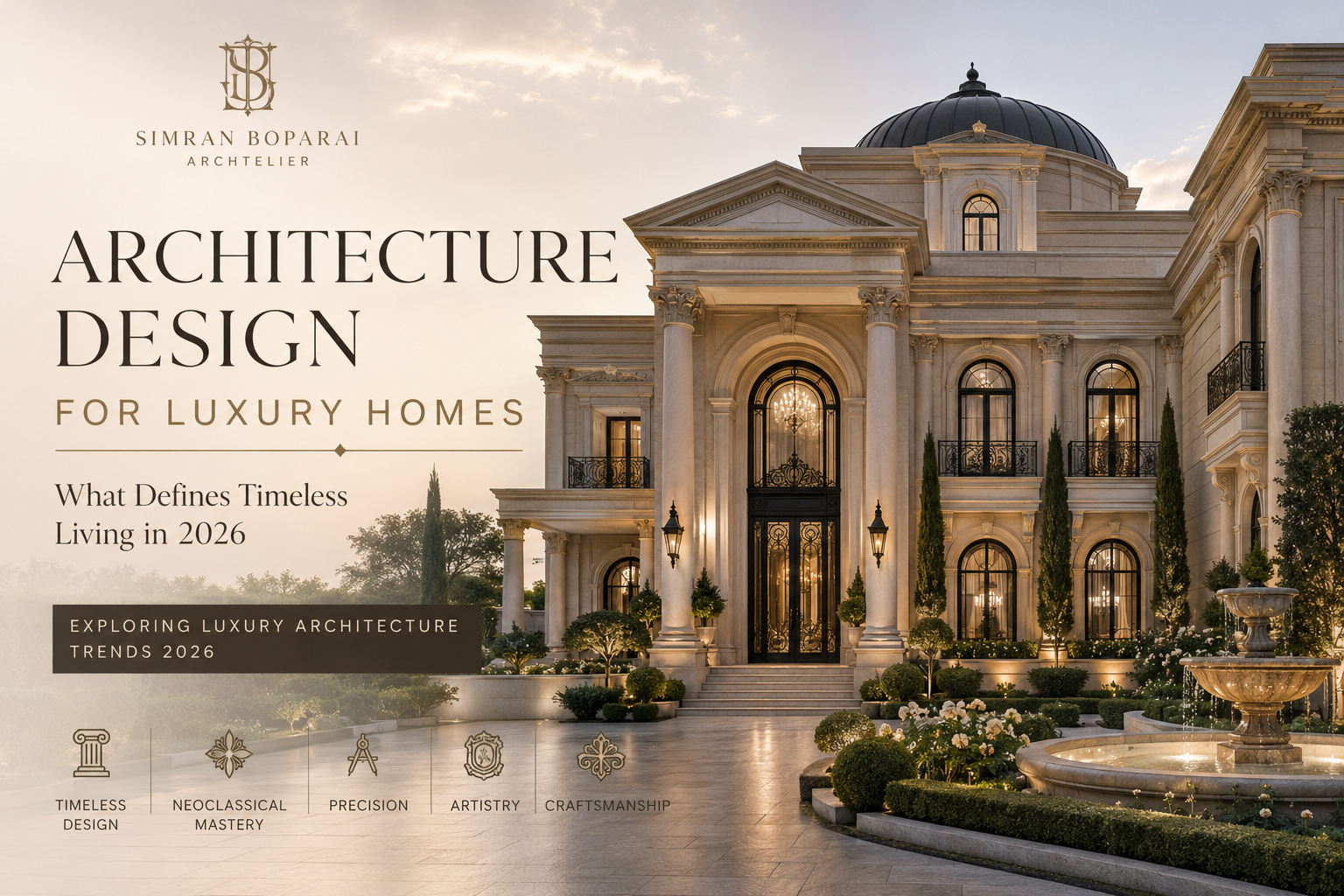
Symmetry, balance, proportion, columns, arches, mouldings, rhythm, and grand spatial planning all create a sense of permanence. When these ideas are adapted for modern living, the result can feel both classic and current.
This is especially powerful for luxury residences.
A neoclassical home can include modern amenities, smart technology, open layouts, wellness spaces, and contemporary materials while still maintaining elegance and dignity.
Architecture design helps control this balance.
Too much ornamentation can make a home feel outdated. Too little detail can make it feel plain. The right approach is measured, refined, and intentional.
This is where Simran Boparai Archtelier’s neoclassical design language has strong relevance for luxury homeowners who want homes with presence, refinement, and long-term visual value.
The Role of Architecture Design in Future-Ready Homes
A future-ready home is not just a smart home. It is a home that can adapt.
In 2026, homeowners need spaces that support changing lifestyles. Work-from-home requirements, wellness routines, family growth, guest hosting, aging parents, sustainability, and technology upgrades all need to be considered.
Architecture design must think ahead.
A room that is used as a lounge today may need to become a home office later. A guest bedroom may need to support elderly parents in the future. A terrace may become a wellness deck. A basement may become an entertainment zone.
Flexible planning protects the long-term value of the home.
The best luxury homes are designed not only for today’s lifestyle, but for tomorrow’s possibilities.
Why Good Architecture Design Adds Long-Term Value
A luxury home is a major investment. Poor planning can create expensive problems later.
Bad circulation, weak natural light, poor room proportions, lack of privacy, impractical layouts, disconnected interiors, and maintenance-heavy materials can reduce both comfort and long-term value.
Strong architecture design helps avoid these issues.
It improves the way the home functions. It makes the structure more efficient. It gives the interiors a better foundation. It enhances the property’s visual identity. It creates spaces that feel comfortable, elegant, and enduring.
For luxury homes, value is not only financial. It is also experiential.
A well-designed home gives its residents ease, pride, comfort, and a strong sense of belonging.
That is the real return on architecture.
Choosing the Right Architecture Design Partner
Choosing an architect for a luxury home should not be based only on attractive images.
The right architecture design partner must understand lifestyle, site conditions, structure, luxury detailing, material behaviour, interior integration, execution practicality, and long-term use.
For homeowners who want a refined residence, the architect should be able to answer important questions:
How will the home respond to the site?
How will privacy be maintained?
How will natural light move through the home?
How will the façade stay timeless?
How will the interiors connect with the architecture?
How will the home support future lifestyle changes?
How will luxury be expressed without excess?
These questions matter because luxury homes are complex. They require more than design taste. They require vision, technical clarity, and execution control.
Conclusion
Architecture design is the foundation of a luxury home.
It defines how the home looks, functions, feels, and lasts. It shapes the entry, the façade, the flow, the light, the privacy, the comfort, the interiors, and the emotional experience of everyday living.
The luxury architecture trends 2026 show that homeowners are moving toward more meaningful design. Wellness, biophilic spaces, quiet luxury, smart integration, sustainability, material intelligence, and timeless architecture are becoming central to high-end residences.
But trends alone do not create great homes.
A truly luxurious residence comes from thoughtful architecture design, strong proportions, refined detailing, personalisation, and a clear design narrative.
For homeowners planning a luxury villa, residence, or custom home, Simran Boparai Archtelier offers a design direction rooted in elegance, neoclassical mastery, precision, and craftsmanship. The result is architecture that does more than impress. It endures.
A luxury home should not be built only for today’s attention.
It should be designed for lasting presence.
FAQs
1. What is architecture design?
Architecture design is the process of planning a building’s layout, structure, façade, spatial flow, function, light, privacy, materials, and overall design experience.
2. Why is architecture design important for luxury homes?
It ensures that the home is not only visually impressive but also functional, comfortable, private, timeless, and suitable for long-term living.
3. What are the key luxury architecture trends 2026?
Key luxury architecture trends 2026 include wellness-led homes, biophilic design, quiet luxury, smart technology, sustainable materials, indoor-outdoor living, and personalised spaces.
4. Is neoclassical architecture still relevant in 2026?
Yes. Neoclassical architecture remains relevant because it is based on timeless principles such as symmetry, proportion, balance, elegance, and refined detailing.
5. Why choose Simran Boparai Archtelier for architecture design?
Simran Boparai Archtelier focuses on luxury architecture with a strong neoclassical design language, precision, artistry, craftsmanship, and attention to detail.
CTA:
Planning a luxury residence or villa? Connect with Simran Boparai Archtelier to create a home where architecture design, lifestyle, and timeless luxury come together with purpose.